Lai Administration Dismisses PLA Exercises as "Cognitive Warfare"
The Storm Media Commentary, December 31, 2025
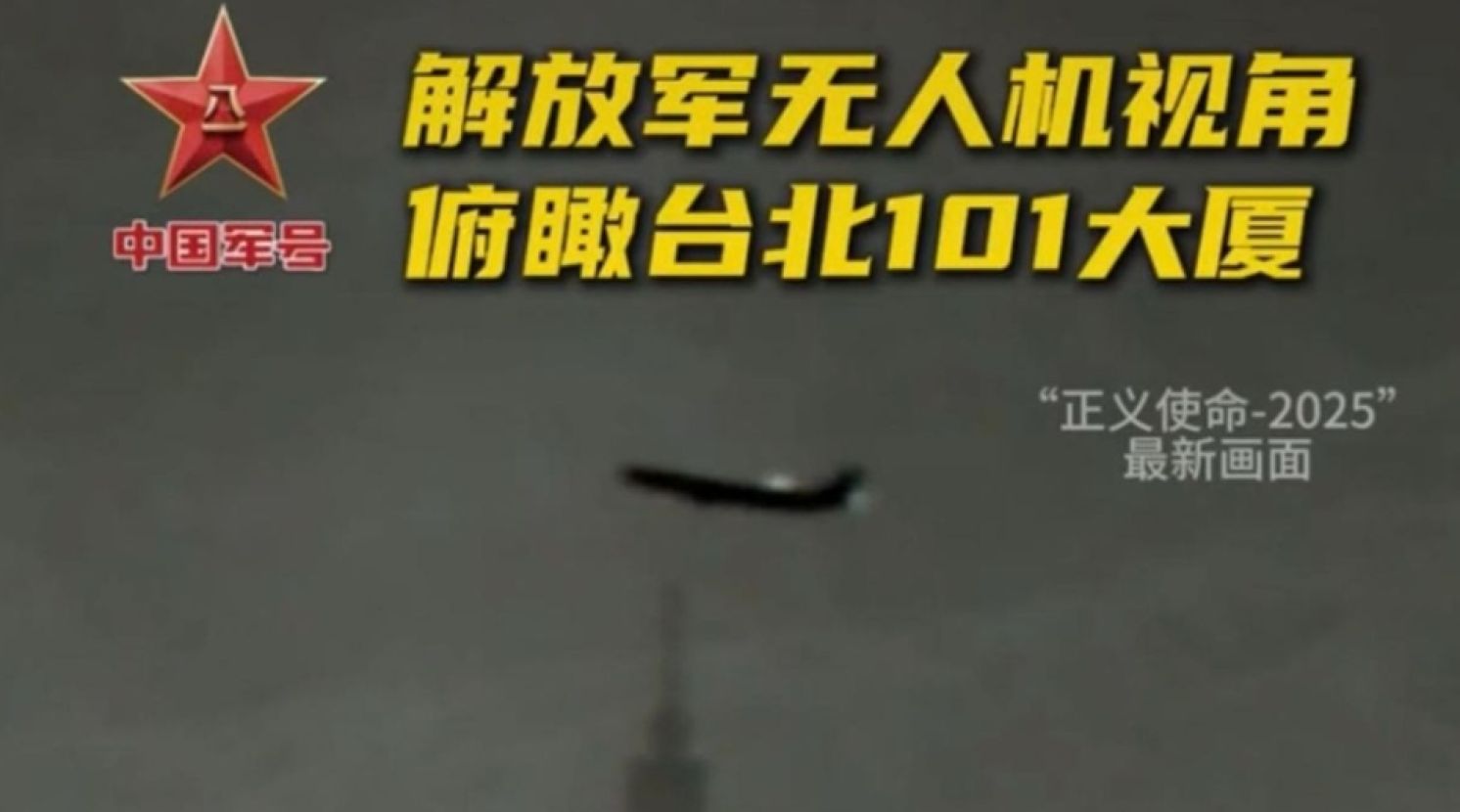
The People’s Liberation Army (PLA) launched the “Justice Mission–2025” encirclement drills around Taiwan without prior warning, approaching Taiwan’s territorial waters and conducting live-fire exercises. In response, President Donald Trump of the United States downplayed the threat posed by the PLA drills, while the Japan maintained a low-key silence. What came as a surprise was that a photograph released by CCTV showing a PLA drone overlooking Taipei 101 unexpectedly became a topic of widespread speculation surrounding the drills. Yet the Ministry of National Defense (MND) claimed this was “cognitive warfare” and urged the public not to be manipulated—does it truly regard “exercises” as merely “acting”?
This marked the fourth encirclement drill around Taiwan since President Lai Ching-te took office, and also the largest military exercise conducted by the PLA against Taiwan since then-U.S. House Speaker Nancy Pelosi’s visit to Taiwan. Beijing’s reasons for launching the encirclement drills are twofold: first, in response to Prime Minister Sanae Takaichi’s “Taiwan contingency” remarks, which have intensified China-Japan confrontation; and second, because the Trump administration approved a US$11 billion arms sale to Taiwan, including offensive weapons such as HIMARS rockets.
Just as the PLA’s encirclement drills came to an end, they were followed immediately by Russia’s military conducting two months of exercises in the Northern Territories starting on New Year’s Day. China and Russia taking turns to showcase military muscle makes their intention to “aim the sword at the United States and Japan” abundantly clear.
This exercise spanning the turn of the year can be regarded as a comprehensive test by the PLA of the “real-combatization of the Taiwan Strait.” The PLA mobilized forces across land, sea, air, and the Rocket Force for this exercise, with the China Coast Guard also joining the drills. An unannounced surprise attack, a lightning-fast blockade, and threats to board and inspect an “Evergreen vessel” carrying HIMARS rockets—this was no longer about missile launches, but rather a gray-zone exercise.
What is laughable is that on the day before the PLA drills, President Lai gave a special interview at the Yunbao armored vehicle factory, claiming that China had not crossed the red line because it “lacked sufficient capability,” inadvertently revealing an attitude of “underestimating the enemy and provoking war.” The MND stated that it was “continuously monitoring the situation,” but this was merely stubborn bluster, putting on a brave face—if intelligence on the drills had truly been obtained in advance, would such a provocatively worded interview have been arranged?
Even more outrageous is President Lai’s claim that the “defense industry is the next guardian mountain of the nation,” while allowing toilet manufacturers, tea merchants, and shoe shops to rush into the arms business, all concentrated in the two cities of Tainan and Kaohsiung. The Lai administration intends to build a “military-industrial complex,” yet completely ignores the lesson of Ukraine’s “massive military corruption.”
As former U.S. Pacific Commander Dennis Blair bluntly stated, Taiwan’s military not only likewise lacks real combat experience, but because of long-term international isolation is unable to conduct high-intensity multinational joint exercises like other countries; even more worrying is that Taiwanese society generally lacks a “sense of urgency for war preparedness.” This mentality of relying solely on U.S. intervention may well be Taiwan’s most dangerous enemy.
When the PLA suddenly launched military drills, Republic of China Army tanks in Kaohsiung caught fire and emitted smoke during emergency readiness operations. After disappearing from public view for a day, President Lai emphasized that he would “not escalate conflict or provoke disputes,” tempering his usual obstinate sharpness, and perfunctorily reassured the public by saying, “Please rest assured.” If PLA drones were to exploit an opening and enter, how could people possibly be reassured? No wonder he has been mocked by an American scholar as a “reckless leader”!
The Art of War by Sun Tzu states: “Which ruler has the moral authority? Which general has the ability? Which side has the advantage of Heaven and Earth? Which side’s laws and orders are enforced? Which army is stronger? Which soldiers are better trained? Which rewards and punishments are clearer? By these I can know who will win and who will lose.” Faced with this, can the Lai administration—whose performance has consistently been chaotic and farcical—not feel ashamed?
A single drone has already breached the psychological defenses of the public. The “AI combat video” released by the Eastern Theater Command shows that unmanned operations against Taiwan—drones, robots, robotic dogs, and unmanned submarines—will be the future trend of warfare. What figures such as Legislator Shen Pao-yang call “cognitive warfare” is nothing more than a “snake-oil plaster” handed out by the Lai administration to the people of Taiwan. Are we really expected to rely on such a “talisman” (or former Premier Su Tseng-chang’s so-called “broom”) to counter the PLA’s unmanned warfare system?
The storm over Prime Minister Takaichi’s “Taiwan contingency” remarks shows that the United States and Japan have already sensed the spillover effects of cross-strait tensions, and their attitudes have become noticeably more cautious and restrained. In responding to the PLA’s military exercises, we should “prepare for the worst,” rather than have the MND hastily label them as “cognitive warfare.” We must not downplay PLA drills as mere “military intimidation,” nor turn a blind eye simply because stocks continue to rise. Such a negligent, indulgent attitude carries a grave warning: Social resilience is nothing more than an empty slogan, and the collective escapism of a willful society is the true face of Taiwan that we refuse to confront.
The Lai administration must not mislead the Taiwanese people: Do not mistake “military exercises” for “theatrics.”